Skip to content

How the model works

Three diagrams, one argument.

What is broken in African restaurant and retail, the platform BRRAL is building for it, and the operations that platform is designed around. Read in order they make one case.

The second and third diagrams describe the model BRRAL is building toward. Today the company operates one brand across three outlets.

The problem

The African industry problem

Three themes, and not one of them is solved by opening another outlet. An independent operator buys at the wrong price, loses stock it has already paid for, and then loses the people who knew how the place ran. Each gets worse with scale rather than better, which is a large part of why African restaurant brands so rarely become groups.
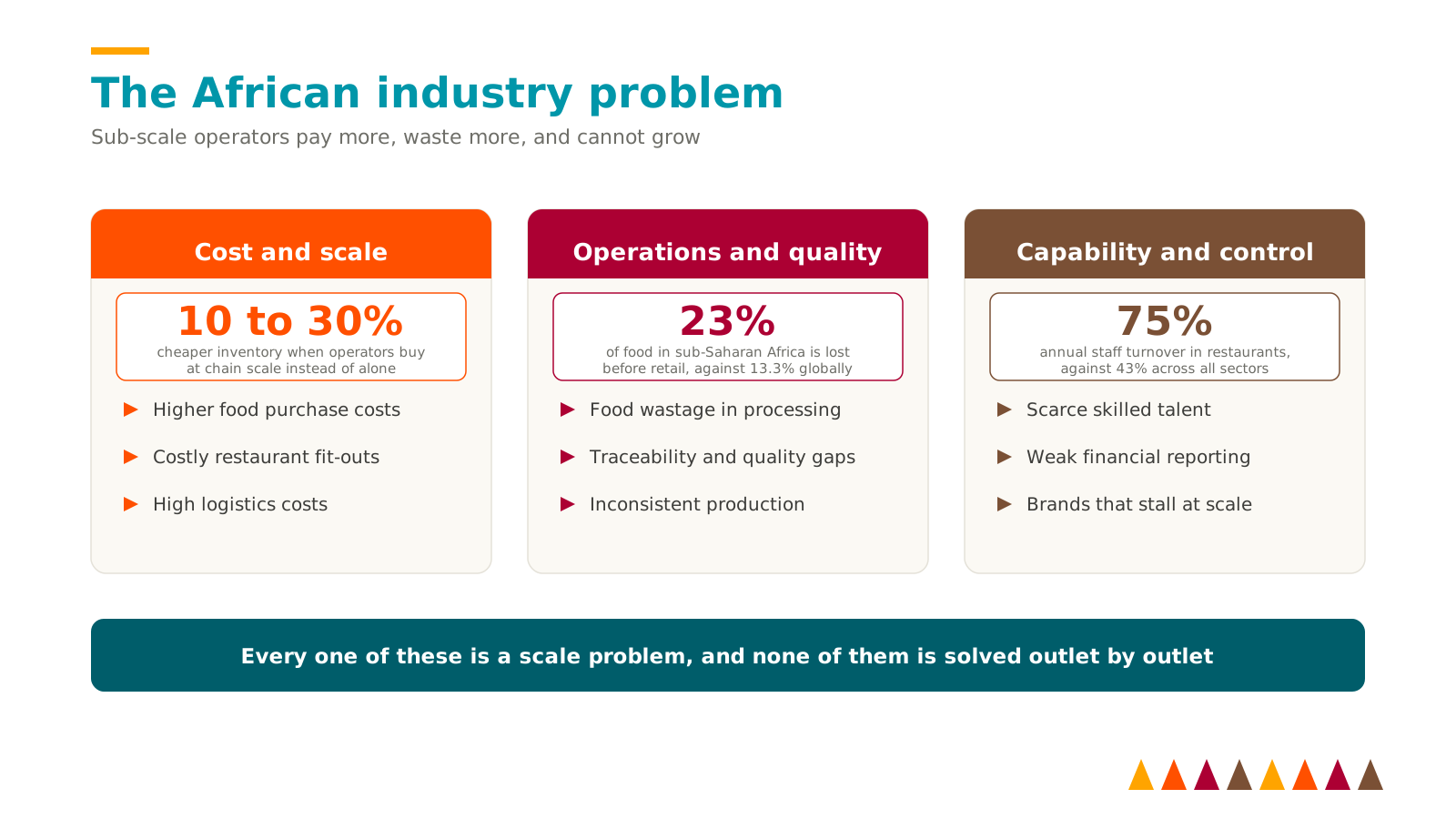
Three themes. Cost and scale: independent operators pay 10 to 30 per cent more for the same inputs than at group scale, with higher food purchase costs, costly restaurant fit-outs and high logistics costs. Operations and quality: 23 per cent of food in sub-Saharan Africa is lost before retail against 13.3 per cent globally, with food wastage in processing, traceability and quality gaps, and inconsistent production. Capability and control: 75 per cent annual staff turnover in restaurants against 43 per cent across all sectors, with scarce skilled talent, weak financial reporting, and brands that stall at scale. Every one of these is a scale problem, and none of them is solved outlet by outlet.
Open this diagram full size (opens in a new tab)

The platform

The BRRAL solution

Eight capabilities, held centrally and shared across every brand in the portfolio. A single restaurant cannot justify a procurement function, a central kitchen, or a finance team producing numbers you can act on. A group of them can, and that is the whole argument.
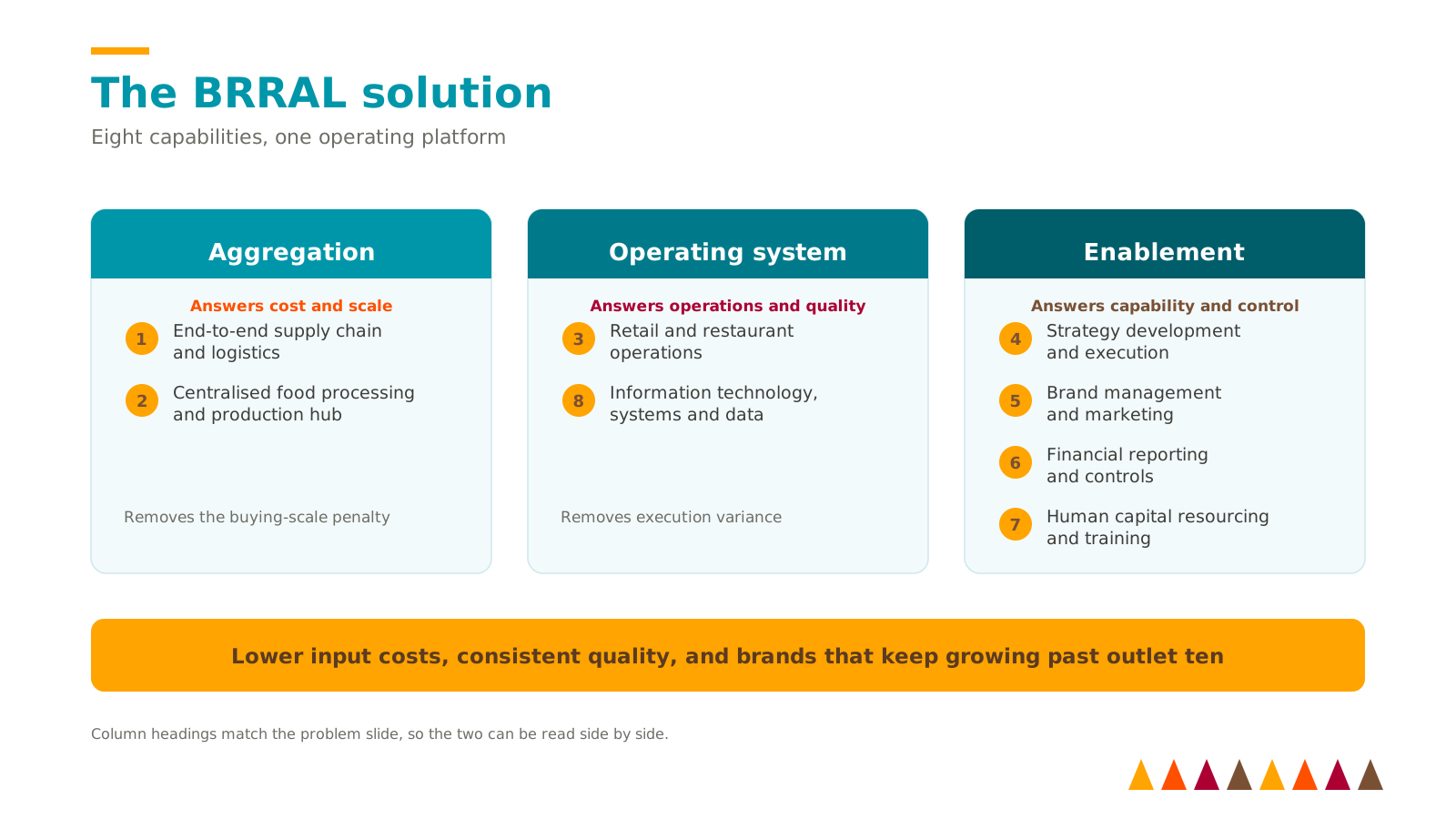
Eight capabilities in three columns forming one operating platform: aggregation, operating system, and enablement. The stated outcome is lower input costs, consistent quality, and brands that keep growing past outlet ten.
Open this diagram full size (opens in a new tab)

The operations

Centralised food and ancillary operations

The machine the platform is built around: one hub preparing, portioning, baking, roasting and packing for every outlet, so a new site opens into a supply chain that already exists rather than building one from nothing. Each line names what it is meant to produce, in the client's own words.
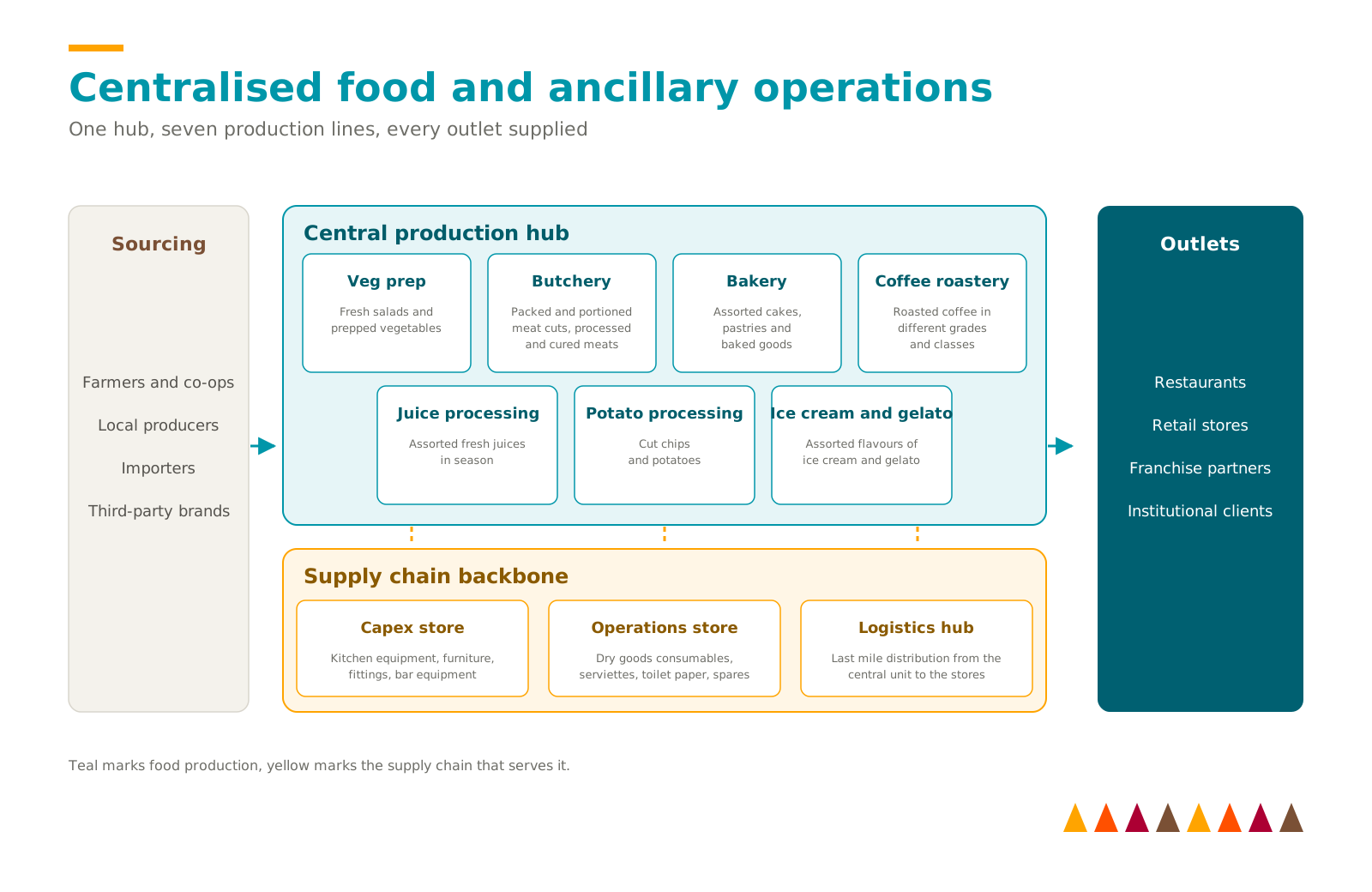
Sourcing from farmers and co-ops, local producers, importers and third-party brands feeds a central production hub of seven lines. Veg prep produces fresh salads and prepped vegetables; butchery produces packed and portioned meat cuts and processed and cured meats; bakery produces assorted cakes, pastries and baked goods; the coffee roastery produces roasted coffee in different grades and classes; juice processing produces assorted fresh juices in season; potato processing produces cut chips and potatoes; and ice cream and gelato produces assorted flavours. Beneath it a supply chain backbone holds a capex store for kitchen equipment, furniture, fittings and bar equipment, an operations store for dry goods consumables, serviettes, toilet paper and spares, and a logistics hub for last mile distribution from the central unit to the stores. All of it supplies restaurants, retail stores, franchise partners and institutional clients.
Open this diagram full size (opens in a new tab)

The detail behind these is in the investor brief.

If you want the working underneath any of it, ask and we will send it.